Showing posts with label Africa. Show all posts

Tuesday, August 13, 2013

Inside the Tagine...

  Welcome back, dear readers, for the continuation of my Moroccan experience! Since we have already covered the fabulous fashion aspect, today we will discover another major part of any culture: its cuisine. And, oh my, where to begin?! I will start with a little background on Moroccan heritage, as it is a very unique blend of several different cultures (don't worry, you won't be quizzed on it ;]). The indigenous people of Morocco are called Berbers, and they are divided into various tribes - some still considered nomadic and some are now "sedentary". The Berber tribes differ due to the varying cultures that have influenced (mostly through invasion and conquest, unfortunately) them over time, from empires like the Romans, Ottomans, and Vandals many centuries ago, to French, Spanish, and Jewish communities in later centuries. All of these influences have since blended and filtered into what is now Moroccan culture and cuisine! To me, that in itself is such a striking aspect of this culture. It has existed for such a great amount of time, seen the arrival of many foreign customs, have adapted them to their way of life, and still maintained their own culture rooted in tradition.
   For instance, I mentioned briefly in my last post about visiting the medinas in each city, which are essentially the "Old Cities," before they expanded and became the modern city of today. Meaning, in every city there is still a large portion of the population that live in the medinas and still practice ways of life as they were hundreds of years ago! We learned that every neighborhood there is required to have four things: 1) a mosque 2) a Koranic school for children 3) a communal bakery (women make their dough at home and bring it to the baker who is then responsible for baking the bread of all the families in that neighborhood - it is also an opportunity for socializing) and 4) a hammam, which is a public bath where people may wash themselves with running water.
It is so hard to these places justice, mostly due to the sheer size and grandeur of each mosque, but this one we visited while inside the medina.

This is the communal bakery where the women bring their dough to be baked by this guy...he has one heck of a memory!

This gives you a bit of an aerial view of the medina, where people live and work. We were actually visiting an old (but still used) local tannery, which explains the giant vats...(the smell was so overpowering, they gave you mint leaves to sniff in case it started to get to ya..)
   The other important feature of the medina is the souqs, which are the shops in the marketplace. Now, this is far from any marketplace in the U.S.; it is composed of extremely narrow, tall walls all winding around to create a serpentine labyrinth, where literally hundreds of thousands of people bustle about. You probably think I'm exaggerating, but I assure you I am not. It is a colossal congregation of life and activity, where everything from shoes and fabrics, lanterns and iron workings, to copper plates and pans are handmade and sold. It is also where people buy all of their foodstuffs. Meats, produce, spices, herbs, and even pastries are overflowing in stands squeezed into small recesses along the medina streets; it is truly a remarkable sight!
Olives, anyone?


Fish on fish on fish

I was not kidding about the narrow corridors!
   Anyway, I digress! I do appreciate your patience; I know this post is supposed to be Moroccan cuisine, but I did feel it's important to see where the food comes from and how, like the medina itself, it is a product of rich and ancient culture. So! back to the task at hand.....
This is a traditional Moroccan salad. It includes pickled zucchini with parsley, cooked carrots with cinnamon, a delicious eggplant spread, a tomato and pepper spread, and a cooked beets and onion combo. I'm tellin' ya, if you like cinnamon, cumin, turmeric, saffron, garlic, parsley, oregano (or any sort of full flavored spice or herb), this, my friend, is the place for you!
The best part is that you eat everything with bread....definitely my kind of place!

Or perhaps you would enjoy a nice leg of lamb? (Thank you to my brother Austin, who so willingly played along with me!)

Kabab mardor - hearty, stew-like, and delicious

These scrumptious little morsels are fried cheese pastries with a nice salty, sorta au jus dipping sauce. I know....I got them every chance I got!

Aziz, our deft and friendly server one night, told us, "presentation is everything," hence his spinning the pastilla, apparently. A pastilla (pronounced pas-ti-ya) is a wondrous layering of fried filo dough so thin you can see through it and a smothering of thick flavored creme (usually orange or rosewater), crisscrossed with cinnamon, sugar, and almonds. Though it was made as a dessert here, pastillas can also be made as a meat dish, replacing the creme layers with free range chicken or...pigeon. Which I ate. And, it wasn't bad (but I'll probably stick with chicken). 

This is just a serving of the pastilla, but I included it because sitting also on that plate is one of the most delicious things that has ever crossed my palate. Rosewater soaked oranges. So simple, yet so mouthwatering good, I subsequently had dreams about them...!
   Alright, my dear, patient followers, only a few more words (and pictures), and I will give you a recipe for the most traditional Moroccan dish, chicken tagine, so you may experience if for yourself! While we were in Marrakesh, we had the chance to take a little cooking class. We were each given an apron, a work station, and a cup of mint tea, of course!
The setup. You may notice a peculiar triangular shaped dish in the upper left corner there. That is called a tagine, where the dish gets its name. It is basically a Moroccan crockpot (but much faster!) Anything can be cooked in it, lamb, chicken, beef, seafood, vegetables, couscous...the list goes on and on

This is The Dada. She is the top chef, so to speak. She runs the kitchen. She didn't speak English, but with the help of a translator, she showed us how everything is done. She was the bomb-digg. 
Everybody hard at work!

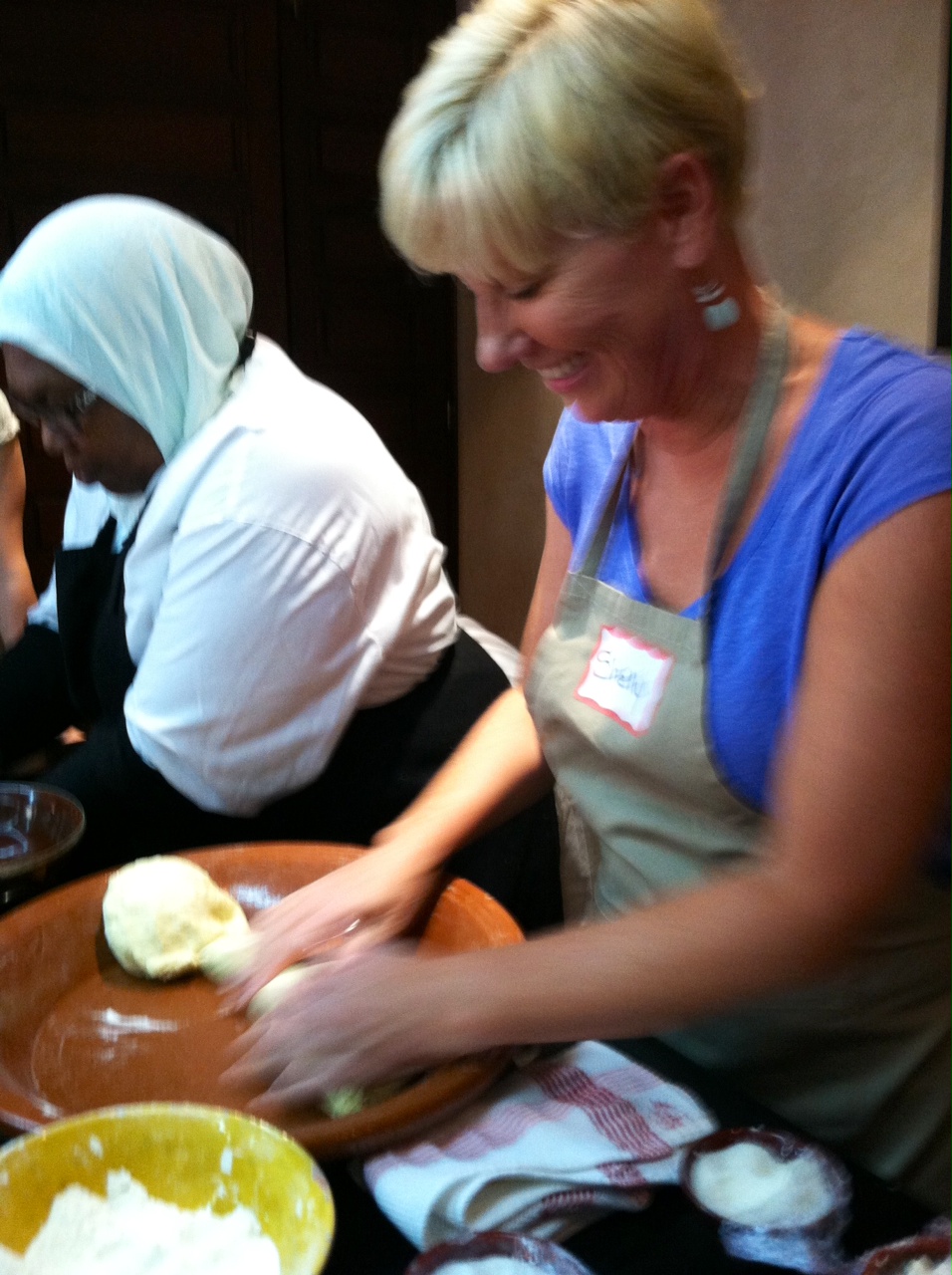
My mom got a chance to roll the dough..and she did, like a pro!


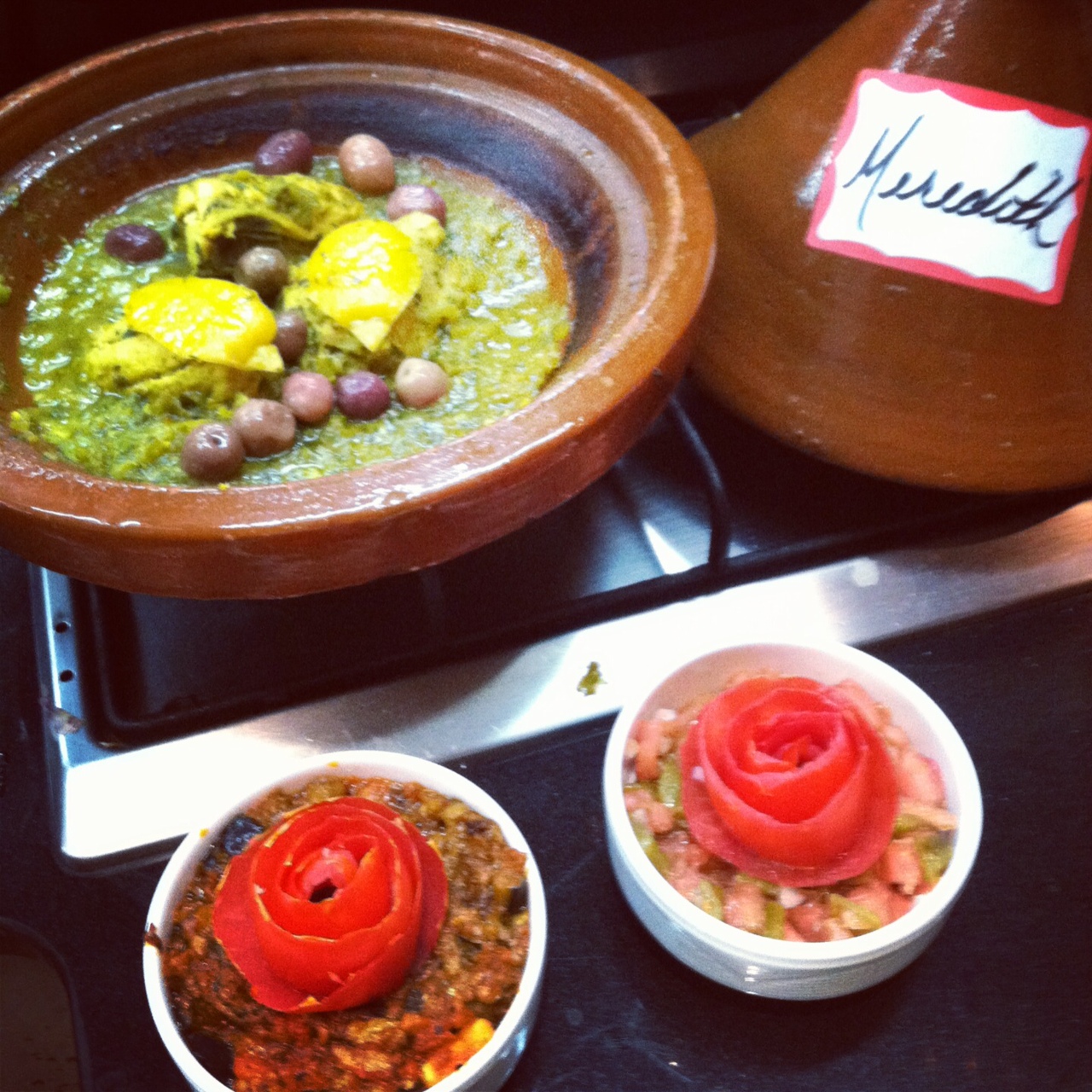
Unfortunately it was a quick-paced class, and I didn't have a photographer to get step-by-step shots, but this is the finished product (and, yes, I did indeed make those tomato roses!), and you will have the instructions to get here.
  Chicken Tagine with Lemon
Prep time: 15 minutes
Cook time: 1 hour

Ingredients:
400 grams of chicken cut in chunks
1/2 of a lemon
1/2 red onion
1 tbs parsley, finely chopped
1 tbs coriander, finely chopped
1 clove garlic
1/2 tbs course salt
1/2 tsp black pepper
1/2 tsp ginger powder
1 heaping tsp turmeric
pinch of saffron
1 tsb olive oil 
1 tsp clarified butter
4 tbs water

Directions:
Cut lemon in half and separate flesh from peel. Chop lemon flesh and place in tagine (or a Dutch oven or creuset), add in finely chopped garlic, parsley, coriander, as well as the remainder of the spices. 
Coat chicken in the marinade and add in finely chopped onion.
Sear the chicken in the tagine on medium heat for twenty minutes, turning chicken over from time to time.
After twenty minutes of searing, add 1/4 liter of cold water and let simmer (lid on) for about 45 minutes, or until chicken has browned and sauce has thickened. 
Add olives and serve!

Zalouk Salad

Ingredients:
1 medium size eggplant
1 heaping tsp cumin
1 tbs finely chopped parsley
1 tbs olive oil
1 large tomato
1 clove garlic
1 tsp salt
1 heaping tsp paprika
1/2 tsp black pepper
Chili powder to taste
1/2 tsp white wine vinegar

Directions:
Partially peel and dice eggplant. In a frying pan, add eggplant, one finely chopped garlic mashed with 1 tsp of salt and 1 tbs olive oil. 
Cook on low heat with lid on for 5 minutes; then, turn and mash eggplant until soft and brown.
Peel and dice a tomato, add to eggplant, add paprika, cumin, pepper, and chili.
Keep mashing until tomato is cooked. 
Add white wine vinegar before you turn off heat and sprinkle with parsley. 
Served cold or warm!

Thanks for sticking through with me on this particularly long piece, but like I said, it is a rich and dynamic culture! Hopefully you enjoyed learning a little more about this awesome country, and hopefully you can add a new exotic dish to your culinary repertoire! 

xoxo, 
Mere 

Pin It Now!

Monday, August 12, 2013

In the Land of 'Veiled Cities'

  Greetings to all you fabulous "Lo and Bee" followers out there! As Bee so graciously introduced me last week, my name is Mere, and I have just returned from a pretty awesome cultural experience. One which I am equally thrilled and honored to be able to share with you now on this outstanding blog created by two outstanding chicks.
  For the last two weeks, my family and I ventured abroad to the country of Morocco. Now, I'll be honest, when I told people I was going to be vacationing there, I was often met with puzzled (slightly concerned) expressions and a lot of "oh-why-Morocco?"s. (I imagine they were just picturing white girl in Northern Africa and immediately jumped to Liam Neeson and Taken.) I'll admit, I thought it a bit of a strange destination myself at first, but now having seen what a vibrant and culturally rich land it is, I would recommend it to anyone!
  Now, like many of those who travel to a distinctly different environment, my first concern was...what the heck do I wear?? I had done my research, and there were two things I knew: Number one- Morocco is an Islamic state (if I remember my statistics correctly, about 98% of the population is Muslim); not wanting to seem insensitive to their way of life and also not wanting to draw unwanted attention, it was decided that knees and shoulders should be kept covered while we were there. Number two- (and this was the tricky part) the average temperature in Morocco in July is about 37 degrees Celsius (ooor 99 degrees Fahrenheit)! So there was my challenge - how to stay cool and comfortable in a place where shorts, tanks, and sundresses are not looked upon all too favorably. The solution? A lotta linen and a lotta scarves. (And maxi dresses, of course!)

I loved these big beautiful doors!

Our guide, Hassan, navigating us through a medina (the old part of the city where the marketplace is).
The family posing in front of a bab (or a city gate). 

You can't go to Morocco and not ride a camel....His name is Othello.

 Once I got over my own fashion dilemma, it was fascinating to observe Moroccan women's own unique fashion style. Initially, in my Westernized view of Islamic fashion, I was hung up on the fact that women seemed limited in their style of dress...it appeared they were all obligated to don the same costume: long kaftans, pants underneath, robe-like garments that cover the whole body and are worn when going out (called a djellaba), and head scarves (hijabs). While these are the key components of a Muslim woman's dress, I could not have been more mistaken about them all being the same. From Fes to Marrakesh to Essaouira, I never saw two women wearing the kaftan or djellaba! I learned that most women custom design their own kaftans and/or djallabas. She will hand pick her fabric, usually silk or cotton, and then take her design to a male tailor (men, not women, make the clothes), which is then followed to her specifications, right down to the embroidery. In fact, I rarely saw a woman in a full black burqa. On the contrary, Moroccan fashion is filled with vibrant colors and patterns, from pastels to rich jewel tones, every color on the spectrum is proudly represented.
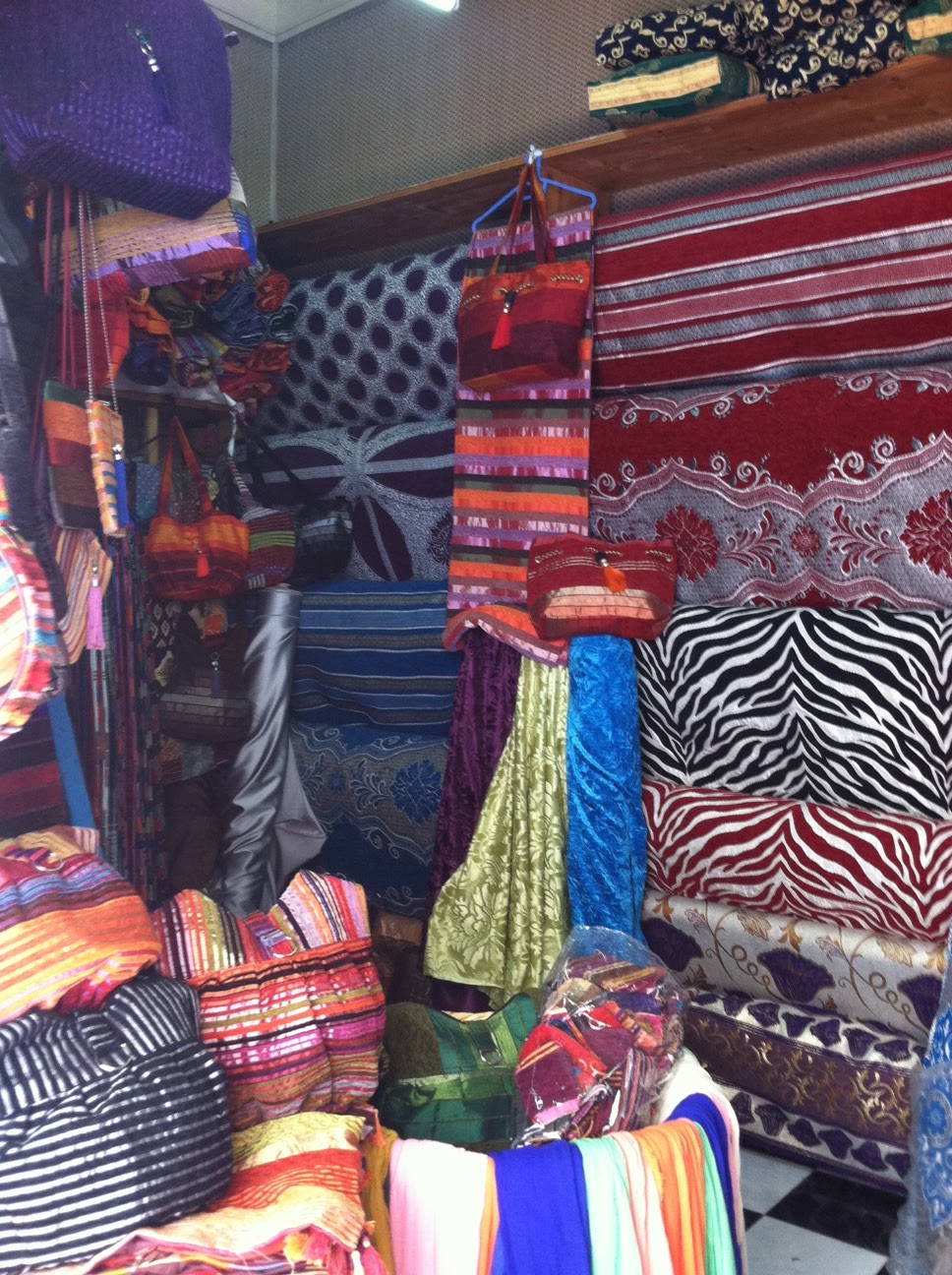
This was taken inside a souq, a large marketplace. (I do apologize for the blurriness, but a lot of times people expect a little money if you take their picture, so I had to do it on the sly...my first stint as a paparazzo!) 


So much to choose from!

  On our first day out, our guide Hassan described to us something that stuck with me for the remainder of the trip. He was explaining to us that many homes and neighborhoods within the cities are hidden behind walls. He said that is because beauty is kept on the inside so it is protected from the Evil Eye on the outside; he called them "Veiled Cities."  I found this not only particularly poetic, but also a useful paradigm for understanding this remarkable culture that does truly revere beauty - made clearly evident in the hand carved marble and mahogany and the tiled floors and walls of their mosques, riads, and homes, as well as in the elaborately patterned and brilliantly colored designs of their fashion.
  I hope you have a enjoyed this little glimpse of Morocco; come on back tomorrow where I will give you a taste of the cuisine (there might even be a recipe for you, if you are feeling adventurous)! Until then....

xoxo,
Mere
Pin It Now!